Completed
6 min read
Towards an Understanding of Therapeutic Provision at the MBS
This study followed on from the Institute of Education project, aiming to get to the heart of what happens at the Mulberry Bush and to explore how the therapeutic environment works.
About the project
The researchers carried out over thirty naturalistic observations, and interviewed seven children towards the end of their stay, thirteen staff working face to face with the children, eight managers, and seven individuals who had referred children.
Key findings
- The Mulberry Bush had clear principles that translated into an effective whole-school practice approach.
- Privacy and emotional intensity in the family home had been experienced as potentially threatening for the children, so the open, public nature of group life at the school was a protection for all concerned.
- Where relationships were shared and relating was very public, the researchers found that, paradoxically, closer one-to-one moments were more safely found.
- Staff were trained to stay close to children's feelings.
- Staff built trusting relationships and worked hard to empathise with the children's present and past experiences.
Publication
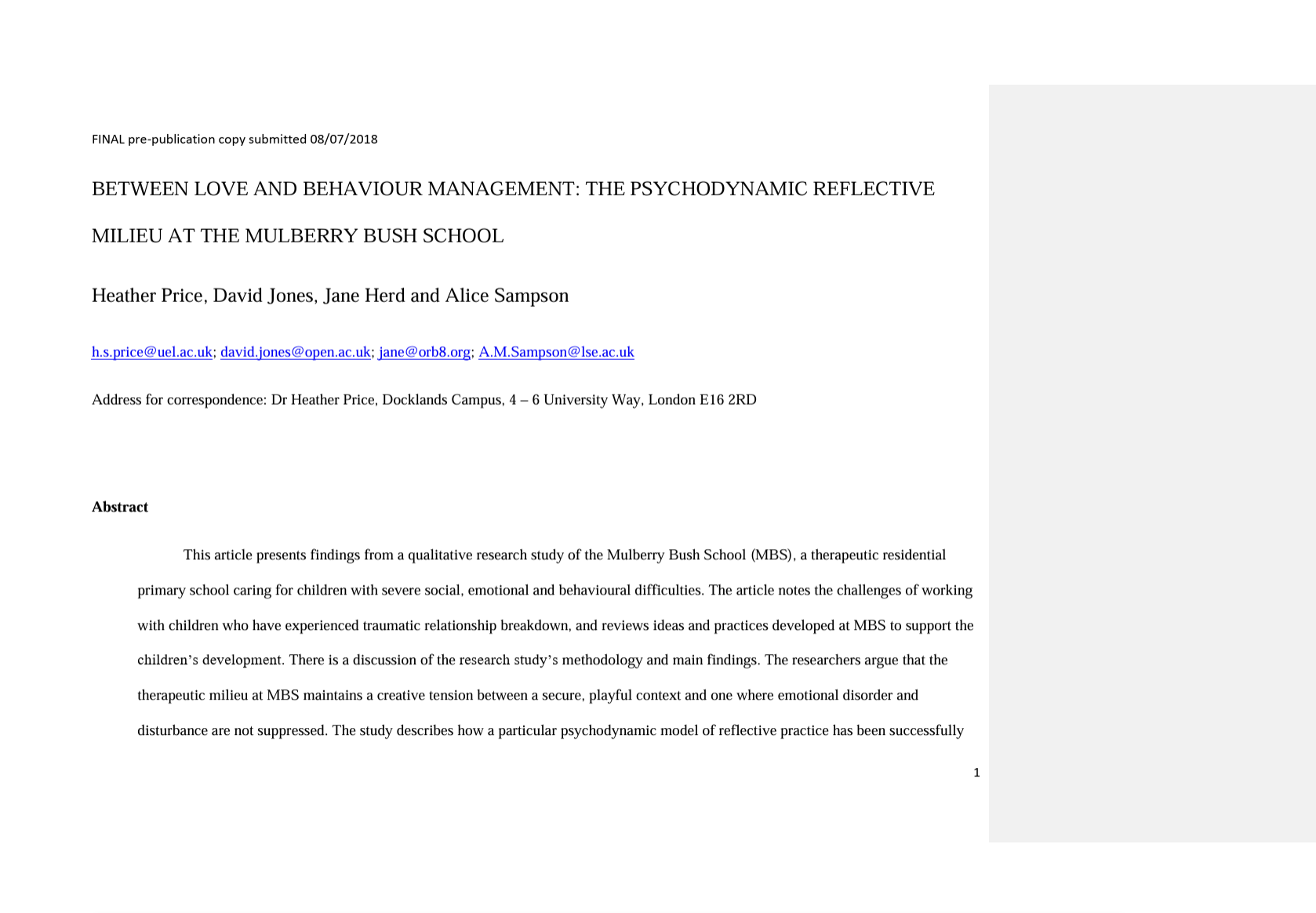
Price, H., Jones, D., Herd, J. and Sampson, A. (2018). Between love and behaviour management: the psychodynamic reflective milieu at the Mulberry Bush School. Journal of Social Work Practice, 32(4), 391–407.